


The universe runs on physics, but sometimes the result looks like pure art. On April 20, 2026, NASA’s Astronomy Picture of the Day puts the spotlight on Eye on the Milky Way.
Credit & Copyright: | apod.nasa.gov
What Is Eye on the Milky Way and What Makes It Look Like This?
Have you ever had
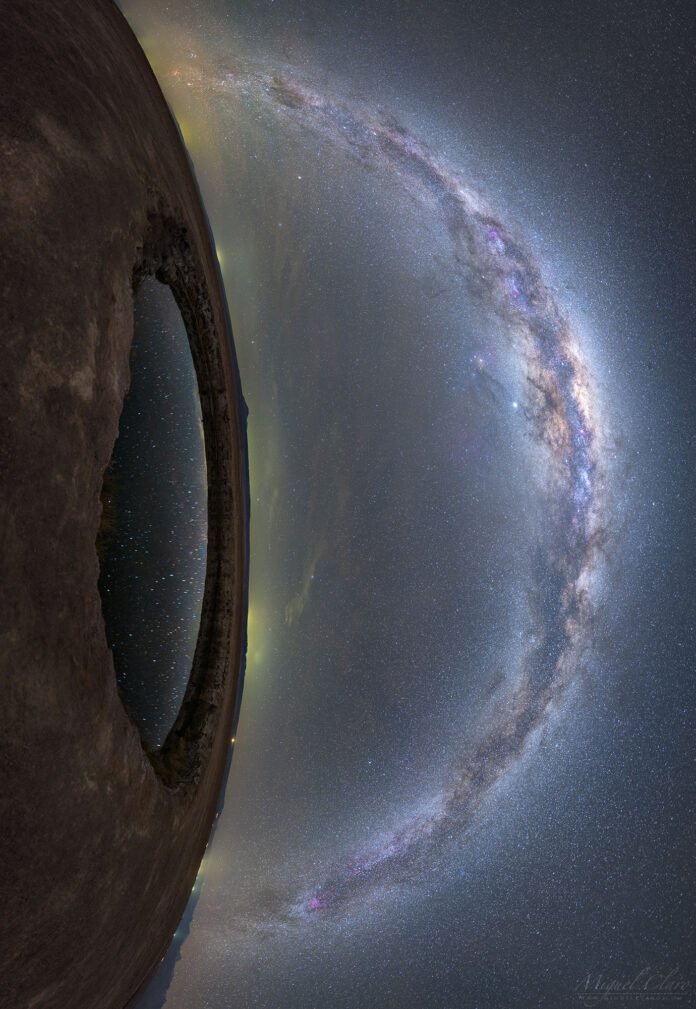
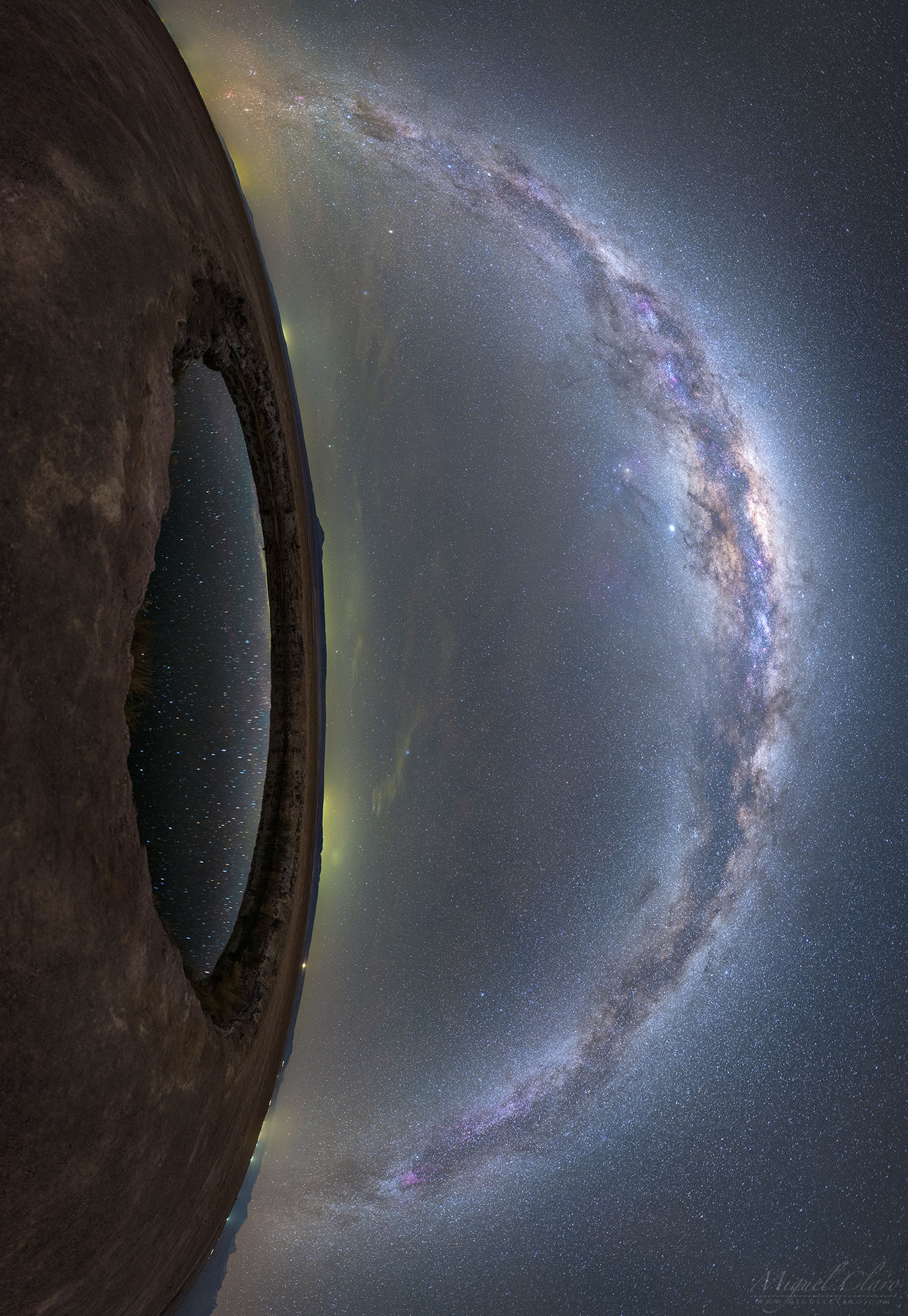
stars in your eyes? It appears that the eye on the left does, and moreover, it appears to be gazing at even more stars.
The
featured 27-frame mosaic was taken in 2019 from
Ojas de Salar in the
Atacama Desert of
Chile. The eye is actually a small
lagoon captured reflecting the
dark night sky
as the Milky Way Galaxy arched overhead. The seemingly smooth band of the
Milky Way is really composed of billions of stars,
but decorated with filaments of light-absorbing dust and
red-glowing nebulas. NASA selected this image for the Astronomy Picture of the Day on April 20, 2026.
For more space discoveries, Astronomy Picture of the Day… covers similar cosmic phenomena in depth.
The Physics That Shaped This Galaxy
Additionally, both
Jupiter
(slightly left the galactic arch) and
Saturn
(slightly to the right) are visible. The lights of small towns dot the
unusual vertical horizon. The rocky terrain around the
lagoon appears to some more like the surface of
Mars than our
Earth.
To image Eye on the Milky Way, astronomers use instruments that go far beyond the human eye. NASA’s Hubble Space Telescope and the James Webb Space Telescope collect light across ultraviolet, visible, infrared, and X-ray wavelengths — each revealing a different physical layer of the object.
For context on how modern space imaging works, NASA APOD April 13, 2026… has related coverage.
How This Image Was Captured and Processed
The image you see for April 20, 2026 is the result of careful calibration, processing, and scientific review. Credit goes to .
Quick Facts: Eye on the Milky Way
| Property | Detail |
|---|---|
| APOD Date | April 20, 2026 |
| Object Name | Eye on the Milky Way |
| Image Credit | |
| Object Type | Galaxy |
| Source | NASA APOD — apod.nasa.gov |
About NASA’s Astronomy Picture of the Day
The Astronomy Picture of the Day has run without interruption since June 16, 1995 — one of the most consistent science communication projects in internet history. Founded by Robert Nemiroff (Michigan Tech) and Jerry Bonnell (University of Maryland), each image is selected by professional astronomers at NASA’s Goddard Space Flight Center.
The April 2026 selection — including Eye on the Milky Way — represents what scientists consider both visually compelling and scientifically meaningful. Browse the full archive free at apod.nasa.gov.
Frequently Asked Questions
What are we looking at in the April 20, 2026 Astronomy Picture of the Day?
Have you ever had
stars in your eyes? It appears that the eye on the left does, and moreover, it appears to be gazing at even more stars. This makes Eye on the Milky Way one of the more compelling subjects in the Astronomy Picture of the Day archive.
How was the structure in Eye on the Milky Way formed?
The
featured 27-frame mosaic was taken in 2019 from
Ojas de Salar in the
Atacama Desert of
Chile. The rocky terrain around the
lagoon appears to some more like the surface of
Mars than our
Earth.
How does the size of Eye on the Milky Way compare to our solar system?
The eye is actually a small
lagoon captured reflecting the
dark night sky
as the Milky Way Galaxy arched overhead. Objects like Eye on the Milky Way frequently dwarf anything in our local cosmic neighborhood, reminding us how small Earth really is on a universal scale.
What do the colors in the Eye on the Milky Way image represent?
Astronomical images often use false-color or narrowband processing to highlight features invisible to the human eye. In the case of Eye on the Milky Way, the color mapping helps scientists identify temperature, composition, and motion within the structure.
What can astronomers learn from studying Eye on the Milky Way?
The rocky terrain around the
lagoon appears to some more like the surface of
Mars than our
Earth. The complete Astronomy Picture of the Day archive going back to 1995 is freely available at apod.nasa.gov/apod/archivepix.html. CCDiscovery.com publishes a detailed article for every new APOD image throughout April 2026.