


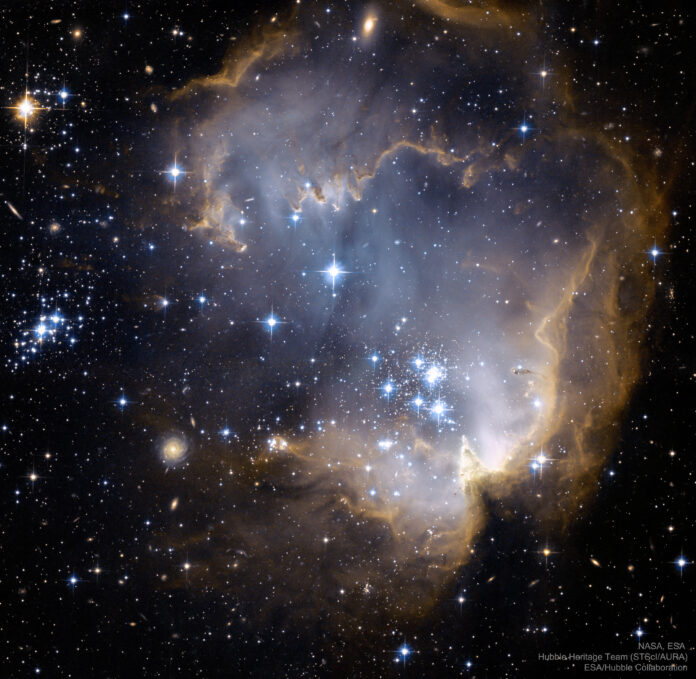
Space never runs out of surprises. This Monday, NASA’s Astronomy Picture of the Day for April 13, 2026 brings us an extraordinary view: NGC 602 and Beyond.
The clouds may look like an oyster, and the stars like pearls, but look beyond. Near the outskirts of the Small Magellanic Cloud, a satellite galaxy some 200 thousand light-years distant, lies 5 million year young star cluster NGC 602. Surrounded by natal gas and dust, NGC 602 is featured in this stunning Hubble image of the region.
What Are We Looking At?
Fantastic ridges and swept back shapes strongly suggest that energetic radiation and shock waves from NGC 602's massive young stars have eroded the dusty material and triggered a progression of star formation moving away from the cluster's center. At the estimated distance of the Small Magellanic Cloud, the featured picture spans about 200 light-years, but a tantalizing assortment of background galaxies are also visible in this sharp multi-colored view. The background galaxies are hundreds of millions of light-years or more beyond NGC 602. This image, courtesy of NASA, was selected as the Astronomy Picture of the Day for April 13, 2026.
Why Does This Image Matter?
Every image NASA selects for its Astronomy Picture of the Day goes through a careful review process by professional astronomers at NASA’s Goddard Space Flight Center. The fact that NGC 602 and Beyond was chosen for April 13, 2026 means it represents something genuinely significant — either scientifically, visually, or both.
Sky Surprise: What picture did APOD feature on your birthday? (after 1995)
The Science Behind the Image
Space photography isn’t just about beautiful pictures. Each NASA APOD image carries layers of scientific data. The colors you see — whether natural or processed — often represent specific wavelengths of light that reveal temperature, composition, or motion. What looks like a painting is actually a map of the universe’s physical properties.
For NGC 602 and Beyond, astronomers and astrophotographers used sophisticated instruments to capture light that the human eye alone could never see. The result is a view of the cosmos that is both scientifically precise and breathtakingly beautiful.
About NASA’s Astronomy Picture of the Day Program
The Astronomy Picture of the Day (APOD) program has been running since June 16, 1995 — making it one of the longest-running daily features on the internet. Founded by astronomers Robert Nemiroff (Michigan Tech) and Jerry Bonnell (University of Maryland), APOD publishes one new image every single day, each accompanied by a brief explanation written by a professional astronomer.
Over its lifetime, APOD has published thousands of images covering everything from nearby planets in our solar system to galaxies billions of light-years away. It remains one of NASA’s most popular public outreach programs, reaching millions of readers worldwide every day.
How to Follow NASA APOD Daily
- Visit the official APOD website at apod.nasa.gov every morning
- Subscribe to the NASA APOD RSS feed for automatic updates
- Bookmark CCDiscovery.com — we publish a full in-depth article for every new APOD image
- Follow NASA’s social media channels for daily space imagery
Key Facts About Today’s APOD (April 13, 2026)
- Title: NGC 602 and Beyond
- Date: April 13, 2026
- Image Credit: NASA
- Media Type: Image
- Source: NASA Astronomy Picture of the Day — apod.nasa.gov
Frequently Asked Questions
What is the NASA Astronomy Picture of the Day (APOD)?
NASA’s Astronomy Picture of the Day is a daily program that features one new space image every 24 hours, along with a short explanation by a professional astronomer. It has been published continuously since 1995 and covers everything from distant galaxies to nearby planets.
What is today’s Astronomy Picture of the Day ()?
Today’s NASA Astronomy Picture of the Day for April 13, 2026 is NGC 602 and Beyond. The clouds may look like an oyster, and the stars like pearls, but look beyond.
Who takes the NASA APOD photos?
NASA APOD images come from a wide variety of sources — professional space telescopes like Hubble, James Webb, and Chandra, as well as talented amateur astrophotographers from around the world. Today’s image (NGC 602 and Beyond) is credited to NASA.
Can I use NASA APOD images for free?
Most NASA images are in the public domain, but some APOD images are copyrighted by the individual photographer or organization that captured them. Always check the specific credit and copyright notice listed with each image before using it.
Where can I see all past APOD images?
The complete archive of all Astronomy Picture of the Day images since 1995 is available at apod.nasa.gov/apod/archivepix.html. You can also browse by date, topic, or keyword using NASA’s APOD search tool.

