


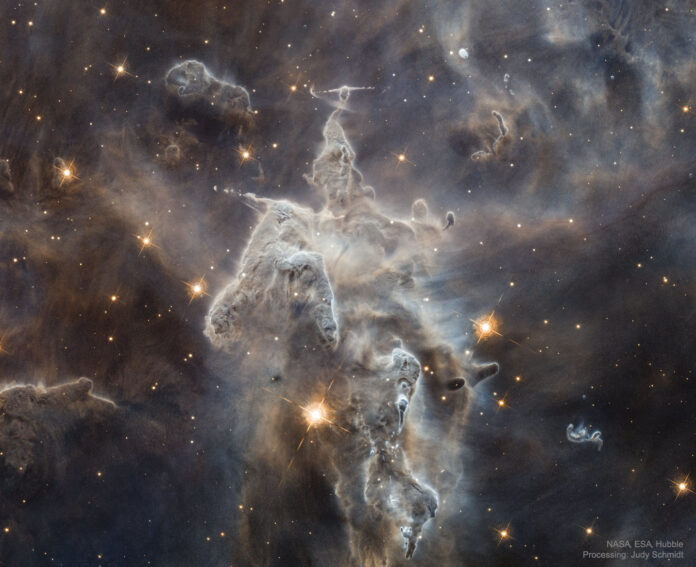
The universe runs on physics, but sometimes the result looks like pure art. On April 27, 2026, NASA’s Astronomy Picture of the Day puts the spotlight on Mystic Mountain Monster being Destroyed.
Credit & Copyright: | apod.nasa.gov
What Are We Seeing Inside Mystic Mountain Monster being Destroyed?
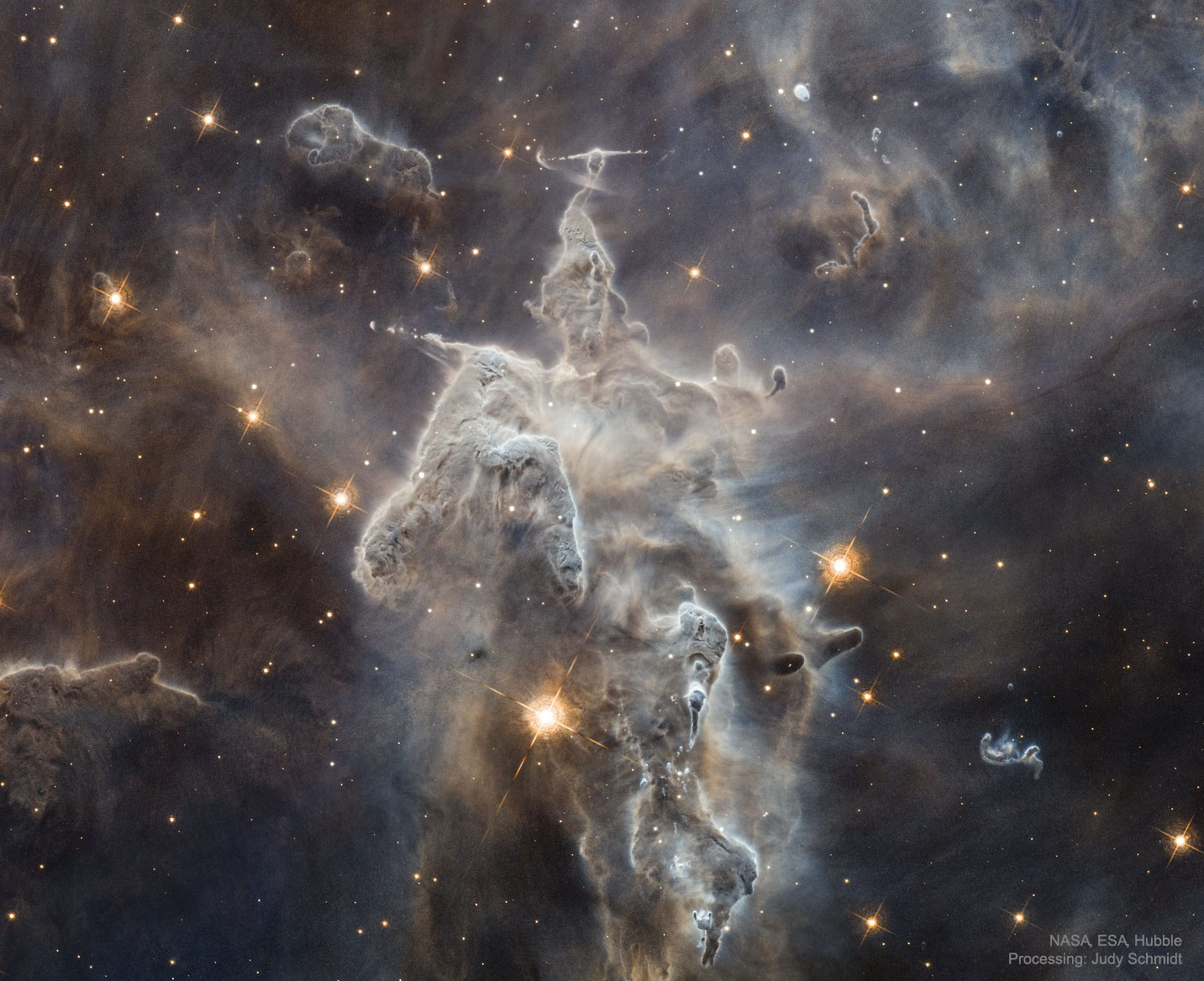
Inside the head of this interstellar monster is a star that is slowly destroying it. The huge monster, actually an
inanimate series of pillars of gas and dust, measures
light years in length.
The in-head star is not itself visible through the
opaque
interstellar dust
but is bursting out partly by ejecting opposing beams of energetic particles called
Herbig-Haro jets. Located about 7,500 light years away in the
Carina Nebula and known informally as
Mystic Mountain, the appearance of these pillars
is dominated by dark dust even though they are composed mostly of clear
hydrogen gas. The featured image was taken with the
Hubble Space Telescope. NASA selected this image for the Astronomy Picture of the Day on April 27, 2026.
For more space discoveries, Astronomy Picture of the Day… covers similar cosmic phenomena in depth.
Star Formation and the Role of Gas and Dust
All over these pillars, the
energetic light and
winds from massive newly formed stars are
evaporating and dispersing the dusty stellar nurseries in which they formed. Within a few million years, the head of this giant,
as well as most of its body, will have been
completely evaporated by internal and surrounding stars.
To image Mystic Mountain Monster being Destroyed, astronomers use instruments that go far beyond the human eye. NASA’s Hubble Space Telescope and the James Webb Space Telescope collect light across ultraviolet, visible, infrared, and X-ray wavelengths — each revealing a different physical layer of the object.
For context on how modern space imaging works, Astronomy Picture of the Day… has related coverage.
How This Image Was Captured and Processed
The image you see for April 27, 2026 is the result of careful calibration, processing, and scientific review. Credit goes to .
Quick Facts: Mystic Mountain Monster being Destroyed
| Property | Detail |
|---|---|
| APOD Date | April 27, 2026 |
| Object Name | Mystic Mountain Monster being Destroyed |
| Image Credit | |
| Distance | 7,500 light years away |
| Object Type | Nebula |
| Telescope | Hubble Space Telescope |
| Source | NASA APOD — apod.nasa.gov |
About NASA’s Astronomy Picture of the Day
The Astronomy Picture of the Day has run without interruption since June 16, 1995 — one of the most consistent science communication projects in internet history. Founded by Robert Nemiroff (Michigan Tech) and Jerry Bonnell (University of Maryland), each image is selected by professional astronomers at NASA’s Goddard Space Flight Center.
The April 2026 selection — including Mystic Mountain Monster being Destroyed — represents what scientists consider both visually compelling and scientifically meaningful. Browse the full archive free at apod.nasa.gov.
Frequently Asked Questions
What are we looking at in the April 27, 2026 Astronomy Picture of the Day?
Inside the head of this interstellar monster is a star that is slowly destroying it. The huge monster, actually an
inanimate series of pillars of gas and dust, measures
light years in length. This makes Mystic Mountain Monster being Destroyed one of the more compelling subjects in the Astronomy Picture of the Day archive.
How was the structure in Mystic Mountain Monster being Destroyed formed?
The in-head star is not itself visible through the
opaque
interstellar dust
but is bursting out partly by ejecting opposing beams of energetic particles called
Herbig-Haro jets. Within a few million years, the head of this giant,
as well as most of its body, will have been
completely evaporated by internal and surrounding stars.
How far away from Earth is Mystic Mountain Monster being Destroyed?
7,500 light years away Even traveling at the speed of light, reaching Mystic Mountain Monster being Destroyed would take an unimaginably long time. Astronomy lets us witness these distant events from our own planet.
What instrument or telescope produced this image of Mystic Mountain Monster being Destroyed?
This image was taken with the Hubble Space Telescope. Credit for this Astronomy Picture of the Day image goes to , whose work made it possible for NASA to select it for April 27, 2026.
Could Mystic Mountain Monster being Destroyed eventually form new stars?
Within a few million years, the head of this giant,
as well as most of its body, will have been
completely evaporated by internal and surrounding stars. The complete Astronomy Picture of the Day archive going back to 1995 is freely available at apod.nasa.gov/apod/archivepix.html. CCDiscovery.com publishes a detailed article for every new APOD image throughout April 2026.