


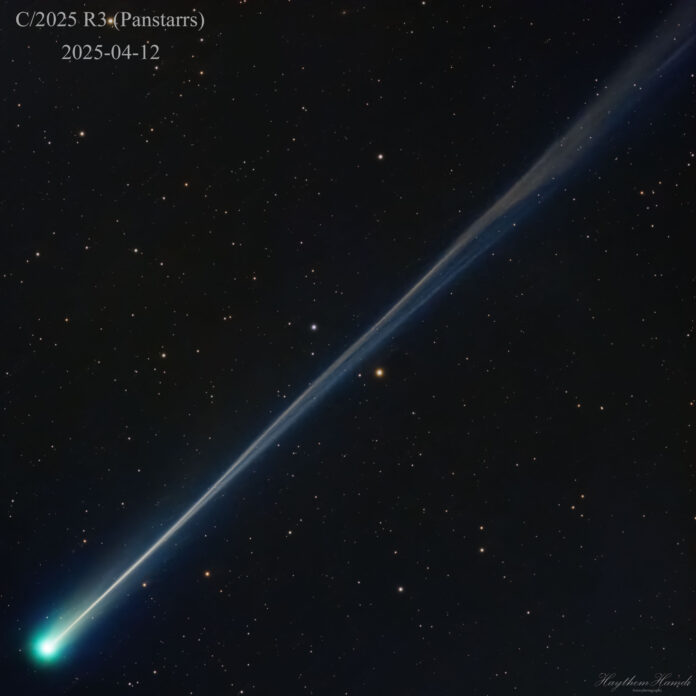
Somewhere in the cosmos, something remarkable is happening right now. NASA’s Astronomy Picture of the Day for April 14, 2026 brings that something to your screen: The Long Wispy Tail of Comet R3 (PanSTARRS).
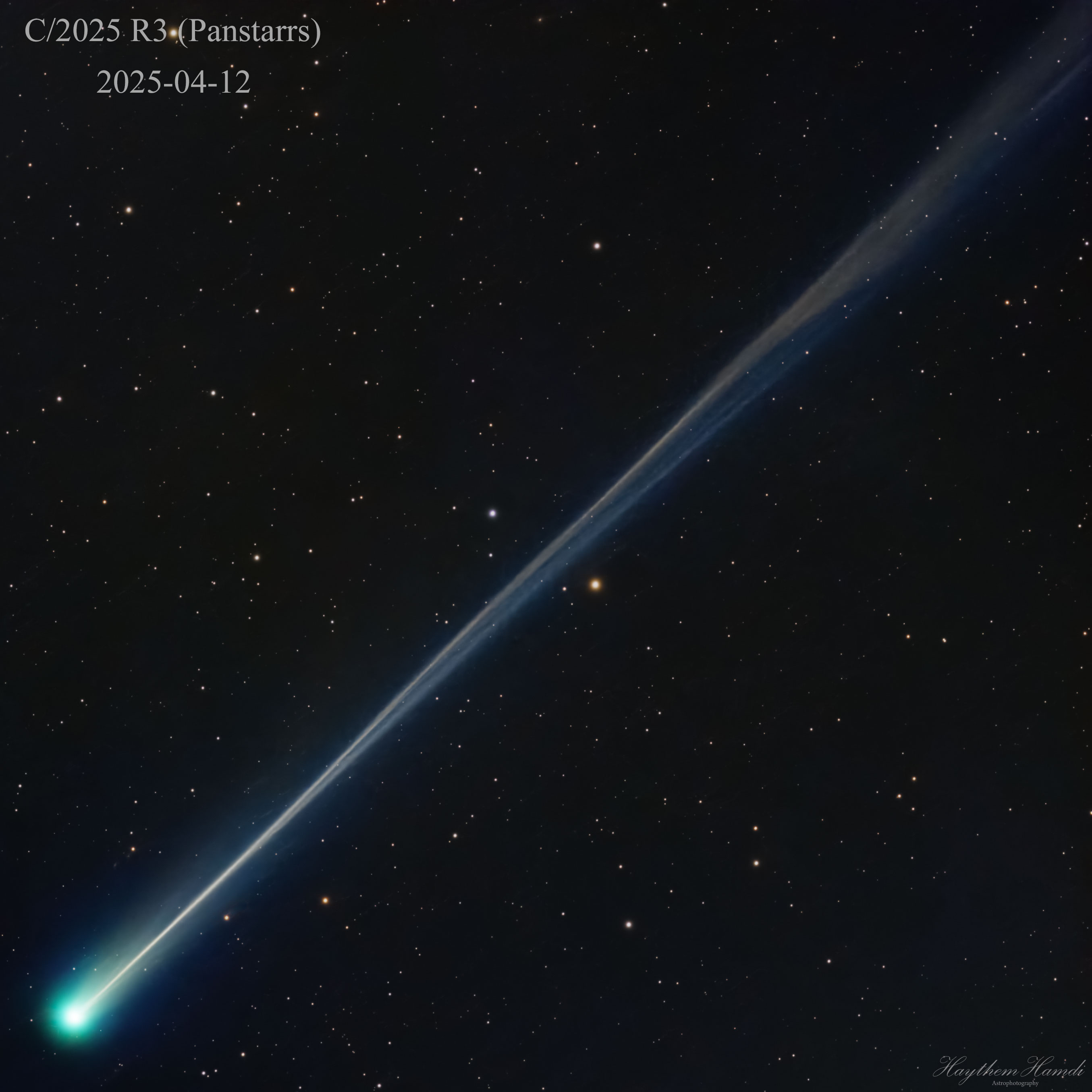
Credit & Copyright: Haythem Hamdi | apod.nasa.gov
What Makes This Image Special
Why does Comet R3 (PanSTARRS) have a wispy tail? The newest bright member of the inner Solar System, Comet C/2025 R3 (PanSTARRS) is already extending an impressive stream of glowing gas.
This tail starts from an unseen central nucleus of dirty ice that is likely a few kilometers across. The nucleus is warmed by the Sun and emits a cloud of neutral gas into a coma that glows light green. Nuclear gas ionized by energetic sunlight is pushed away from the Sun by the solar wind into an ion tail that glows light blue. This image was captured by Haythem Hamdi and selected by NASA for the Astronomy Picture of the Day on April 14, 2026.
For more images like this, Astronomy Picture of the Day… goes deeper on similar cosmic phenomena.
The Science You Cannot See With the Naked Eye
The wispy nature of the ion tail is caused by the constantly changing structure of the solar wind. Pictured from Rhode Island, USA two days ago, Comet R3 (PanSTARRS) shows off a many-degree ion tail. Comet R3 (PanSTARRS) is best seen before dawn from northern skies for another 10 days, after which it will be best visible from southern skies.
To image The Long Wispy Tail of Comet R3 (PanSTARRS), astronomers use instruments that go far beyond what the human eye can detect. NASA’s Hubble Space Telescope and the James Webb Space Telescope collect light across ultraviolet, visible, infrared, and X-ray wavelengths — each layer revealing a different physical property of the object.
If you want to understand how modern space imaging works, Astronomy Picture of the Day… has related coverage.
How This Image Was Captured and Processed
Comet R3 (PanSTARRS) is best seen before dawn from northern skies for another 10 days, after which it will be best visible from southern skies. Growing Gallery: Comet R3 in 2026
The final image you see for April 14, 2026 is the result of careful calibration, processing, and scientific review. Credit goes to Haythem Hamdi.
Quick Facts: The Long Wispy Tail of Comet R3 (PanSTARRS)
| Property | Detail |
|---|---|
| APOD Date | April 14, 2026 |
| Object Name | The Long Wispy Tail of Comet R3 (PanSTARRS) |
| Image Credit | Haythem Hamdi |
| Object Type | Comet |
| Source | NASA APOD — apod.nasa.gov |
About NASA’s Astronomy Picture of the Day
The Astronomy Picture of the Day has run without interruption since June 16, 1995 — one of the most consistent science communication projects in internet history. Founded by Robert Nemiroff (Michigan Tech) and Jerry Bonnell (University of Maryland), each image is selected by professional astronomers at NASA’s Goddard Space Flight Center.
The April 2026 selection — including The Long Wispy Tail of Comet R3 (PanSTARRS) — represents what scientists consider both visually compelling and scientifically meaningful. Browse the full archive free at apod.nasa.gov.
5 Questions About This Image
Can you explain what The Long Wispy Tail of Comet R3 (PanSTARRS) actually is?
Why does Comet R3 (PanSTARRS) have a wispy tail? The newest bright member of the inner Solar System, Comet C/2025 R3 (PanSTARRS) is already extending an impressive stream of glowing gas. This makes The Long Wispy Tail of Comet R3 (PanSTARRS) one of the more compelling subjects in the Astronomy Picture of the Day archive.
What scientific phenomenon does The Long Wispy Tail of Comet R3 (PanSTARRS) illustrate?
This tail starts from an unseen central nucleus of dirty ice that is likely a few kilometers across. Growing Gallery: Comet R3 in 2026
How does the size of The Long Wispy Tail of Comet R3 (PanSTARRS) compare to our solar system?
The nucleus is warmed by the Sun and emits a cloud of neutral gas into a coma that glows light green. Objects like The Long Wispy Tail of Comet R3 (PanSTARRS) featured in the Astronomy Picture of the Day frequently dwarf anything in our local cosmic neighborhood, reminding us how small Earth really is on a universal scale.
Who captured the April 14, 2026 Astronomy Picture of the Day?
The image of The Long Wispy Tail of Comet R3 (PanSTARRS) was captured by Haythem Hamdi. Why does Comet R3 (PanSTARRS) have a wispy tail? NASA reviewed this submission and selected it for April 14, 2026 based on its scientific and visual significance.
Where can I see more NASA Astronomy Picture of the Day images like The Long Wispy Tail of Comet R3 (PanSTARRS)?
Growing Gallery: Comet R3 in 2026 The complete Astronomy Picture of the Day archive going back to 1995 is free at apod.nasa.gov/apod/archivepix.html. CCDiscovery.com publishes a detailed article for every new APOD image throughout April 2026.

. Today's NASA space image explained by professional astronomer)